
IA on the job: in Basel, when is a precedent genuinely reusable?

Reusing an earlier project seems reasonable when teams need to prepare a method transfer, a scientific collaboration or a logistics change. The management question is more precise: what needs checking before applying an earlier solution suggested by AI to a new assignment?
What the literature establishes
Mary L. Gick and Keith J. Holyoak (1980, Cognitive Psychology) studied how a solution encountered in a story can help people solve a structurally analogous problem. Their experiments show that having a precedent available does not guarantee its spontaneous use: a prompt to make the connection can facilitate transfer. This research concerns human reasoning, not generative assistants.
What needs to be similar
Dedre Gentner (1983, Cognitive Science) proposes a theoretical framework in which analogy rests on correspondences between relations rather than merely on the attributes of objects. Two projects may share terminology, an industry and a timeline without depending on the same conditions for success. When examining a connection suggested by AI, this framework encourages us to ask which dependencies are genuinely shared.

The premature conclusion
One might conclude that an assistant capable of finding similar projects can also identify transferable solutions. That would confuse the availability of a precedent with the validity of applying it. A method used in an international R&D collaboration is not necessarily transferable if responsibilities, data access rights or validation requirements have changed. (our executive and employee training programmes)
What this research does not establish
The problem-solving experiments and theoretical framework cited do not establish the effectiveness of an AI application in pharmaceuticals or life sciences. Nor do they provide a threshold for declaring two projects sufficiently analogous. In practice, asking an assistant to justify a connection provides something to examine, not independent validation.
A practical check in Basel
Within SHR’s « IA on the job » programme, one possible exercise in Basel is to compare an earlier file with a new case, both cleared for this use—for example, an international R&D procurement case involving life sciences and Rhine logistics. Before accepting a solution suggested by AI, the team records the condition that made it work, evidence that this condition holds in the new case, and any difference that could invalidate the transfer. The measure is the proportion of accepted recommendations whose necessary conditions a designated domain expert has verified against documents in the new case file. This rate measures the discipline of transfer, not the project’s future success; an unverified condition explicitly remains an assumption. To go further: explore the AI on the Job training in Basel in the canton of Basel-Stadt, or browse our executive and employee training programmes in Switzerland.
In pictures: AI on the Job in Basel
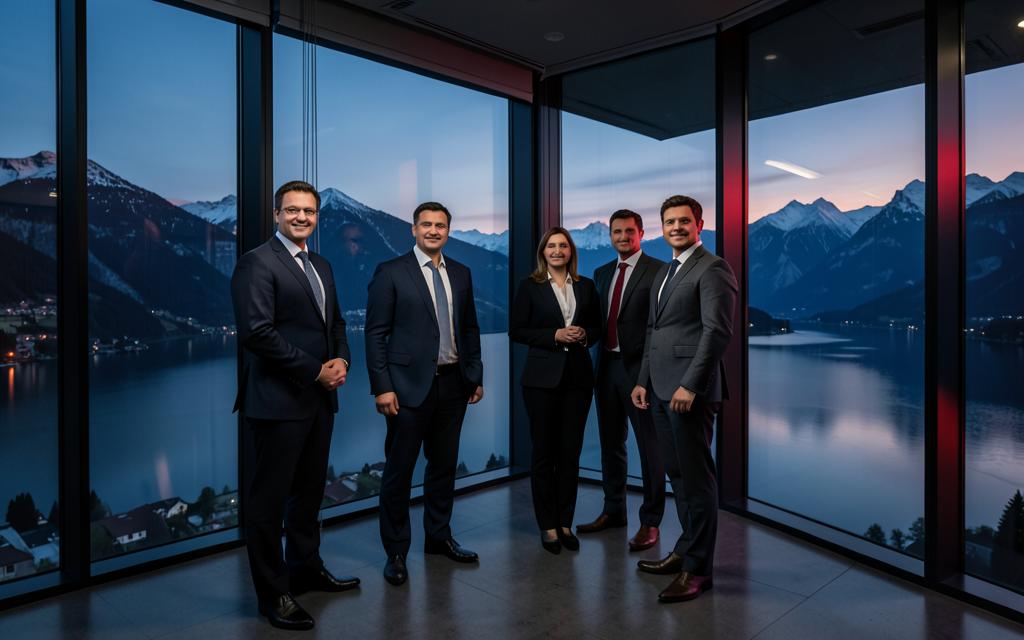


- ai on the job
- Basel
- research
- training basel