
Customer reception: preparing for exceptions before they arise
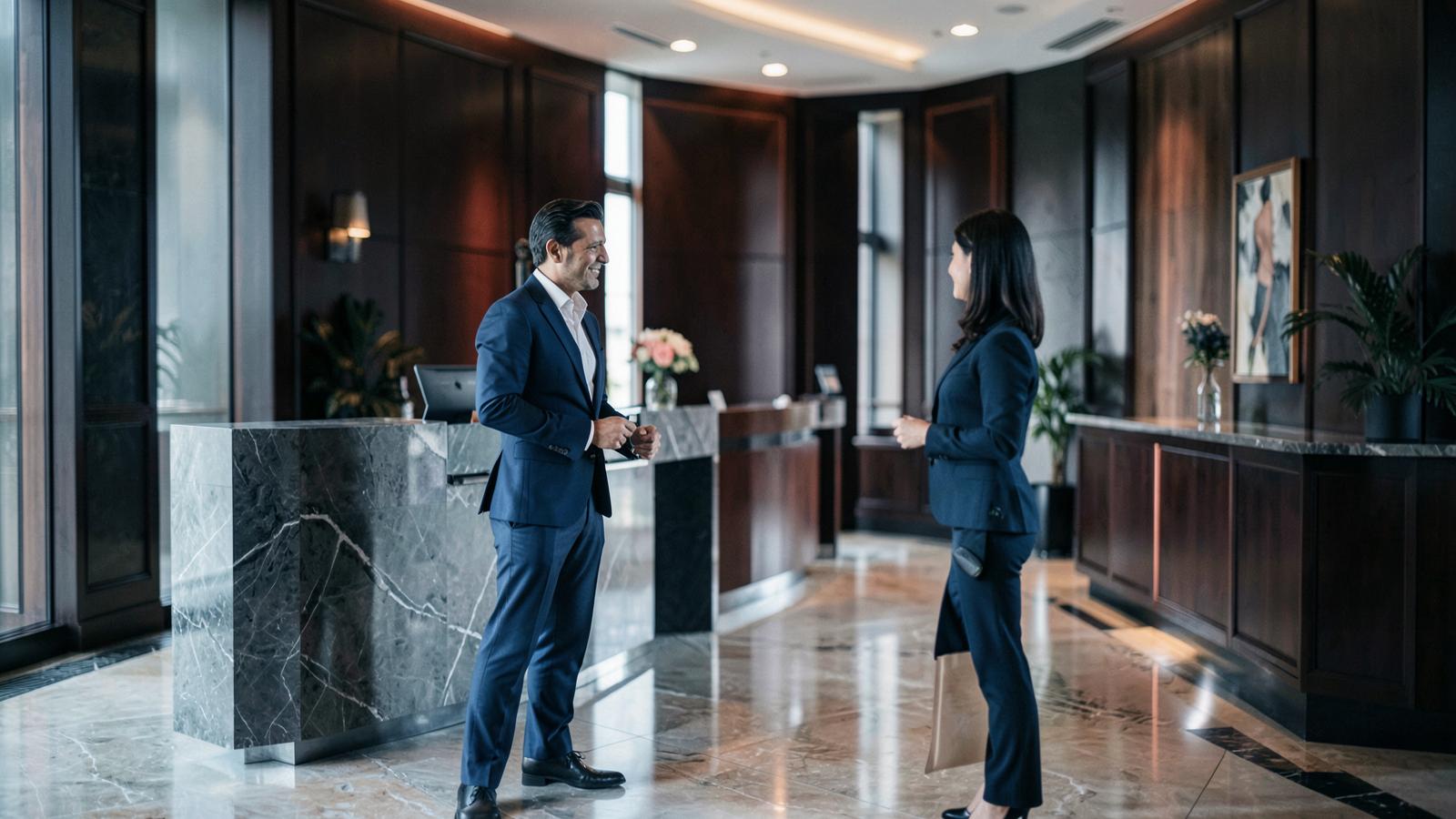
At reception, some difficulties arise when an unusual situation requires a familiar but rarely used action. The managerial question is specific: does preparing an explicit link between an observable cue and an authorised action help staff handle these exceptions?
What the literature establishes
Peter Gollwitzer and Veronika Brandstätter (1997, Journal of Personality and Social Psychology) studied implementation intentions: plans specifying when, where and how to act to achieve a goal. Their findings show that forming a general intention and preparing its execution are not equivalent, particularly when initiating action is difficult. For reception work, this suggests a distinction between knowing an exception procedure and identifying the situation that should trigger it.
The mechanism: linking a cue to a response
Peter Gollwitzer (1999, American Psychologist) provides a theoretical synthesis of research on these plans, often expressed as “if this situation arises, then I will take this action”. The proposed mechanism combines greater accessibility of the anticipated cue with more direct initiation of the response. At a site reception desk, an example would be: “If a visitor’s authorisation cannot be confirmed, I contact the designated person before allowing entry.”

The premature conclusion
It might be tempting to conclude that a response should be prepared for every possible incident. These studies justify neither an unlimited catalogue of scenarios nor the mechanical application of a response to a situation that merely looks similar. The plan should address a sufficiently precise cue and an authorised action, which may mean requesting a decision rather than resolving the problem independently. (our executive and employee training programmes)
What the evidence cannot promise
These publications do not evaluate reception operations at pharmaceutical sites, logistics platforms or R&D centres in Basel. They provide no basis for promising improved customer satisfaction or fewer security incidents in these settings. A plan may also remain ineffective if the designated contact is unavailable or the procedure provides no fallback: preparing the trigger is no substitute for having the means to act.
A practical check in Bâle
Within SHR’s “Accueil client” programme, one possible application in Basel would be to select, with the site manager, an exception relevant to pharmaceuticals, life sciences, Rhine logistics or international R&D: for example, the arrival of a visitor whose authorisation cannot be confirmed. Over two periods of equal duration, before and after introducing an “if–then” plan, record the proportion of these cases in which the designated contact is approached before anyone is admitted, without recording visitors’ identities. Separately recording cases where the contact cannot be reached and cases where the cue was misinterpreted would help distinguish a failure to initiate action from an organisational failure. This local comparison would not, on its own, establish causality, but it would make a specific behaviour verifiable rather than relying on a general impression of competence. To go further: explore the Client Reception training in Basel, or browse our executive and employee training programmes in Switzerland.
In pictures: Client Reception in Basel
- client reception
- Basel
- research
- training basel