
Customer reception: does working under a visitor's gaze make a difference?

At reception, the same person must establish contact and carry out sometimes complex operations in front of the visitor. The management question is specific: should every operation be performed while maintaining continuous interaction with the visitor?
What the literature establishes
Robert B. Zajonc (1965, Science) offers a classic explanation of social facilitation: the presence of others favours dominant responses, those that come most readily. When those responses suit the task, performance may improve; when a situation requires a less familiar response, performance may deteriorate. This theoretical synthesis does not specifically address reception work, but it challenges the assumption that being observed has a uniform effect on performance.
The distinction between speed and accuracy
Charles F. Bond and Linda J. Titus (1983, Psychological Bulletin) show in their meta-analysis that the effects of others' presence vary with task complexity and the performance measure used. Their synthesis distinguishes, in particular, faster responses on simple tasks from reduced accuracy on complex tasks. For reception work, this suggests a distinction worth testing: issuing a routine badge and resolving an access exception do not necessarily require the same conditions for success.

The premature conclusion
One might conclude that complex operations should always be performed out of the customer's sight. These studies justify neither that general rule nor the opposite assumption that an experienced professional should always be able to work while maintaining a continuous conversation. The relevant distinction concerns how familiar the operation is to the person performing it, not simply their job title. (our executive and employee training programmes)
What the evidence cannot settle
The experimental settings brought together in this literature do not reproduce a reception desk combining conversation, access control and information searches. Nor is the presence of an observer equivalent to that of a visitor asking questions or expressing impatience. These findings therefore cannot attribute a reception error solely to the customer's gaze or quantify the benefit of redesigning the workstation.
A practical check in Bâle
Within SHR's « Accueil client » programme, a Basel-based simulation could compare routine registration with a fictional access exception, drawing on visits in pharma, life sciences, Rhine logistics and international R&D. Each participant completes comparable versions with a silent visitor present and without a visible observer, alternating the order of the conditions and using no real data. The main measure is the proportion of cases completed without omitting a mandatory check, assessed against a predefined checklist; processing time remains a separate indicator. If errors cluster around exceptions handled under observation, this provides grounds for testing a brief verification phase explained to the visitor, without removing checks or assuming the result will generalise to everyday practice. To go further: explore the Client Reception training in Basel, or browse our executive and employee training programmes in Switzerland.
In pictures: Client Reception in Basel

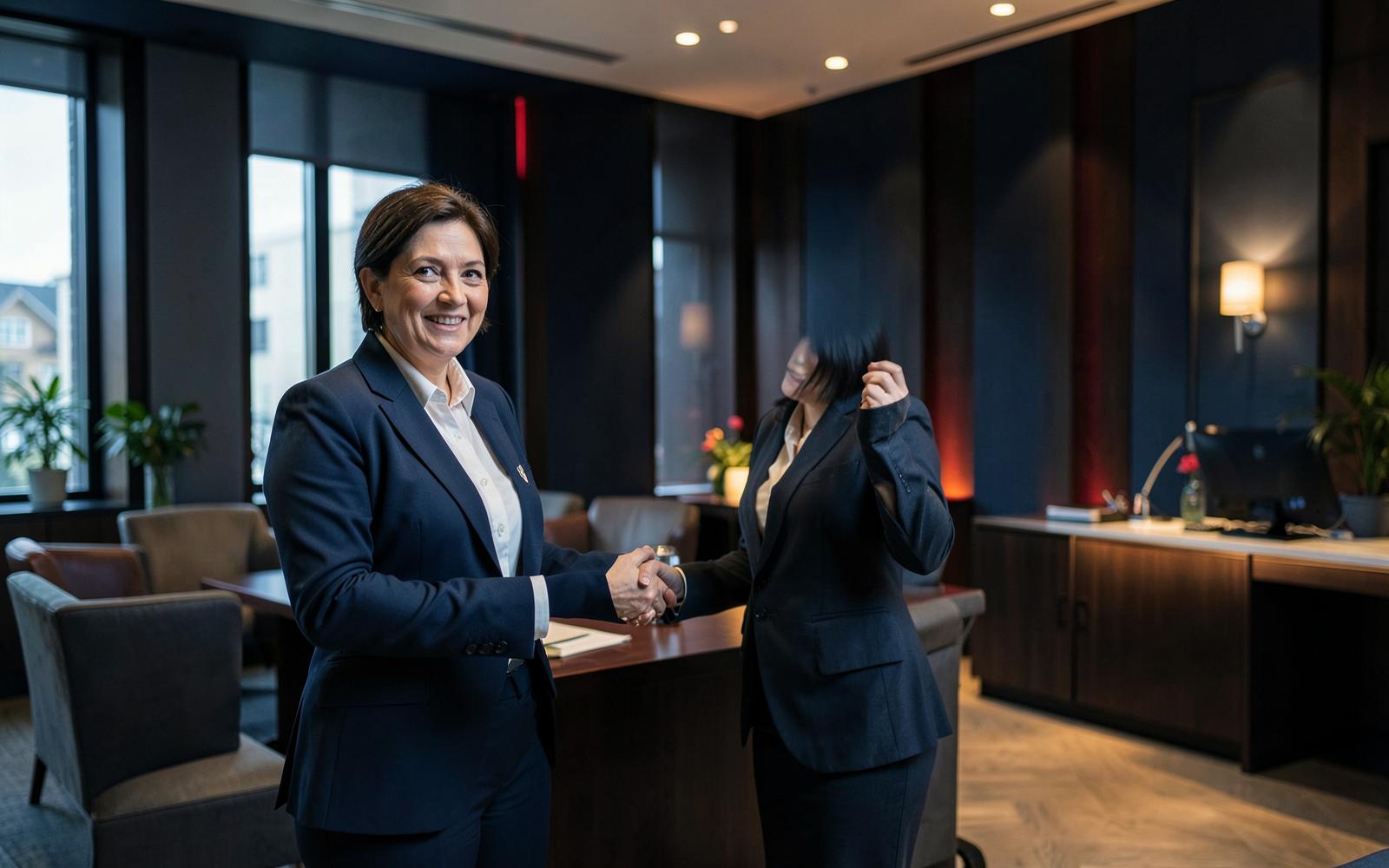
- client reception
- Basel
- research
- training basel