
Customer reception: does politeness make a rule sound negotiable?

At reception, some requests are part of the service; others are conditions for authorised access to a site or laboratory. The management question is specific: how can staff communicate an obligation without damaging the relationship or leaving visitors to infer that compliance is mandatory?
What the literature establishes
Steven Pinker, Martin A. Nowak and James J. Lee (2008, Proceedings of the National Academy of Sciences) offer an analysis of indirect speech: it does more than convey a request, also helping speakers negotiate their relationship. Ambiguity can therefore serve a social function rather than simply reflect poor wording. At reception, this analysis invites scrutiny of what a phrase such as “You could perhaps show your badge” implies when showing it is mandatory.
A reason can influence behaviour without providing information
Ellen J. Langer, Arthur Blank and Benzion Chanowitz (1978, Journal of Personality and Social Psychology) studied requests to go ahead of someone at a photocopier. Under certain low-cost conditions, a reason containing little new information increased compliance; this effect did not generalise when the request became more costly. The experiment thus distinguishes the effect of a request’s form from that of its content, without establishing that someone who complies has understood why a rule is necessary.

The premature conclusion
One might conclude that staff should simply remove tentative wording and always add “because”. These studies justify neither authoritarian communication nor empty reasons used to secure compliance. A more defensible approach is to distinguish a sign of consideration, an explicit obligation and an accurate reason: “Thank you for having your badge ready; checking it is mandatory before you enter this area.” (our executive and employee training programmes)
What these findings cannot guarantee
The analysis of indirect speech is not a training trial involving reception staff, and the photocopier experiment does not concern access to regulated facilities. These articles therefore measure neither safety incidents nor visitor satisfaction in Basel companies. More explicit instructions remain an improvement hypothesis to test, particularly when conversations take place in a second language.
A practical check in Bâle
In SHR’s “Accueil client” programme, a role-play can involve an international R&D partner arriving at a pharmaceutical or life sciences laboratory, or a driver arriving at a Rhine logistics site in Basel. Before and after work on wording, run comparable scenarios and ask the simulated visitor to explain what is mandatory before entry. The indicator is the proportion of explanations correctly identifying this condition, supplemented by a record of access decisions that comply with procedure. This check assesses understanding and reception practice without experimenting with actual site security. To go further: explore the Client Reception training in Basel, or browse our executive and employee training programmes in Switzerland.
In pictures: Client Reception in Basel

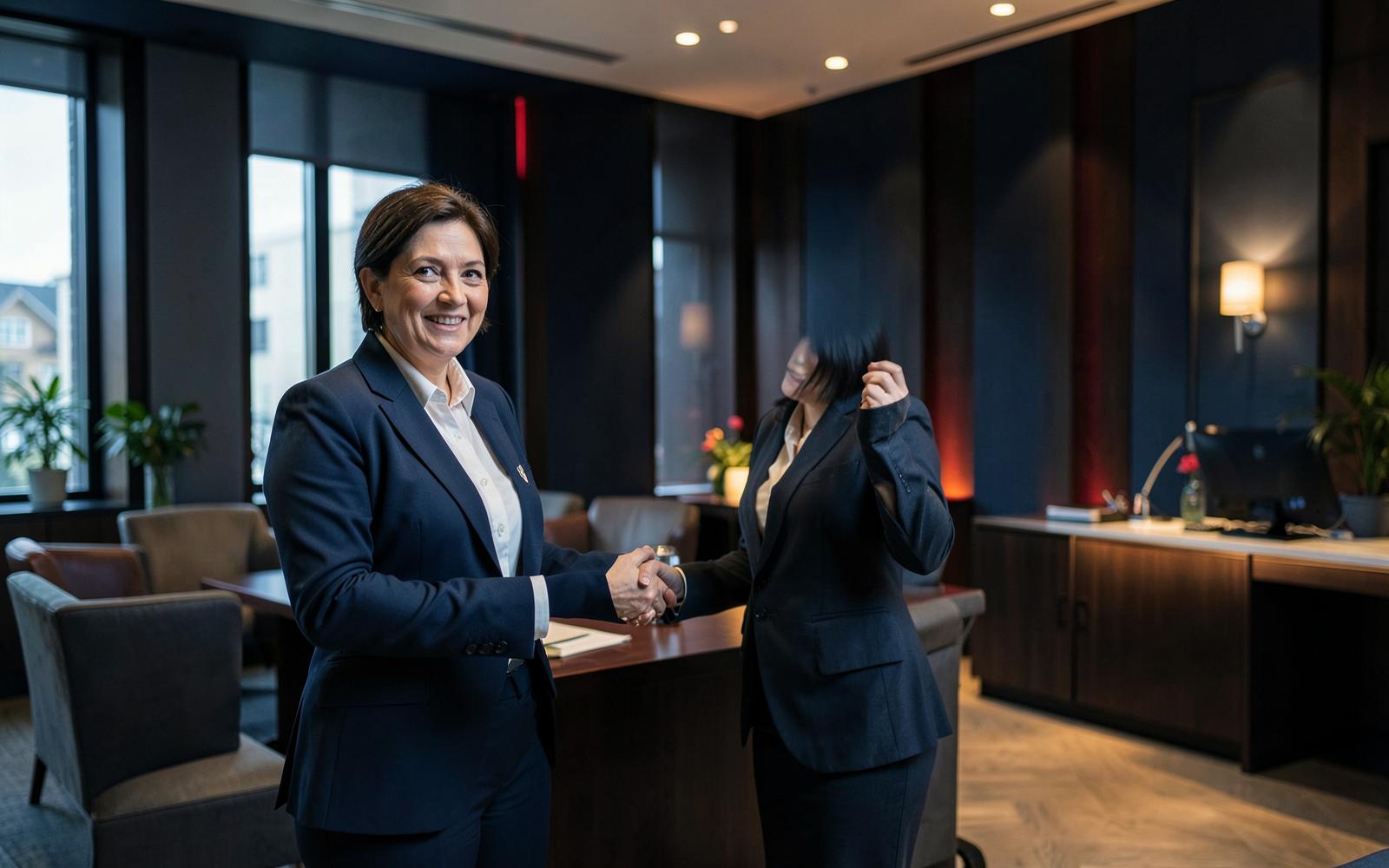
- client reception
- Basel
- research
- training basel