
Customer reception: what the setting communicates before the first contact
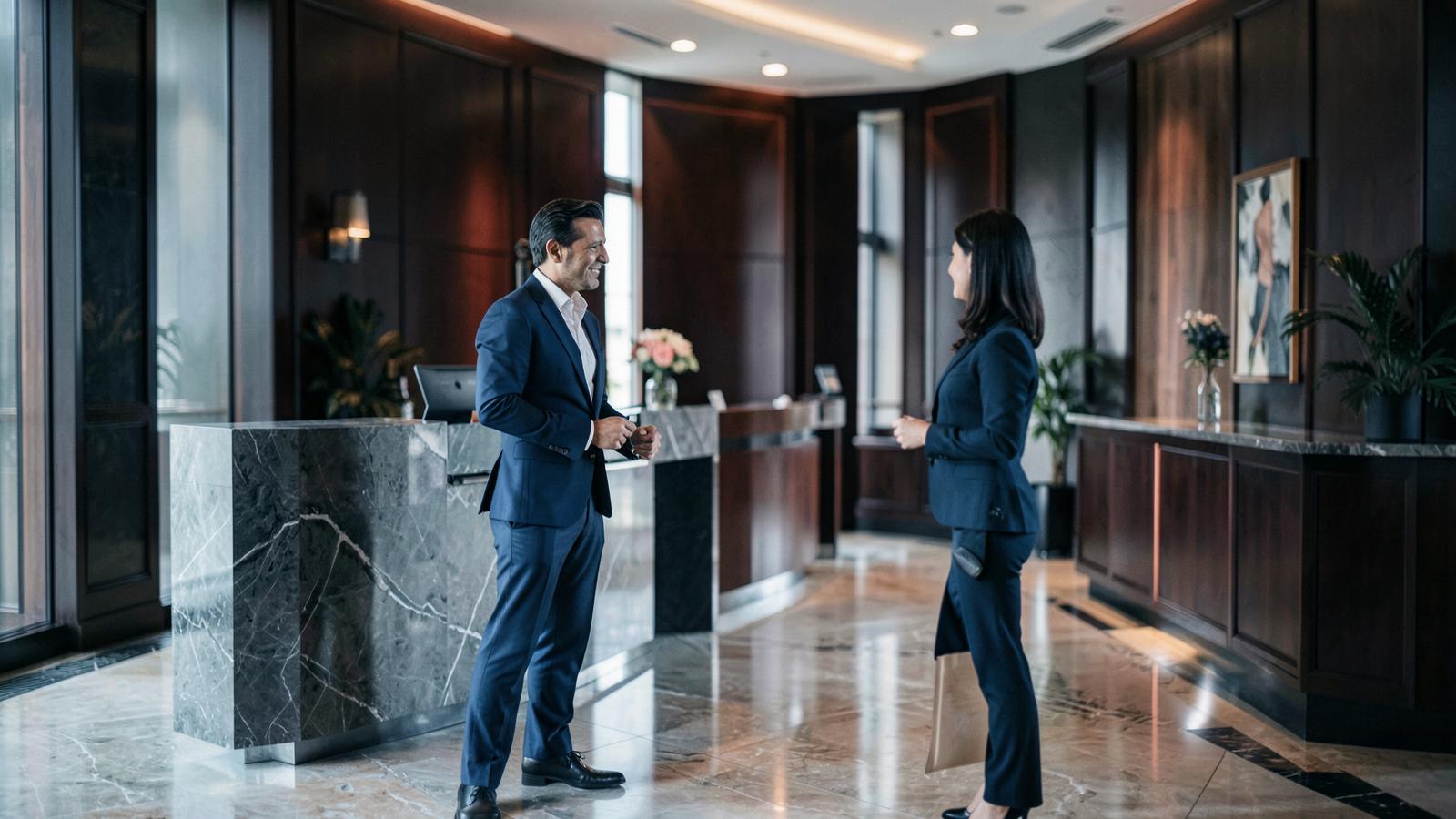
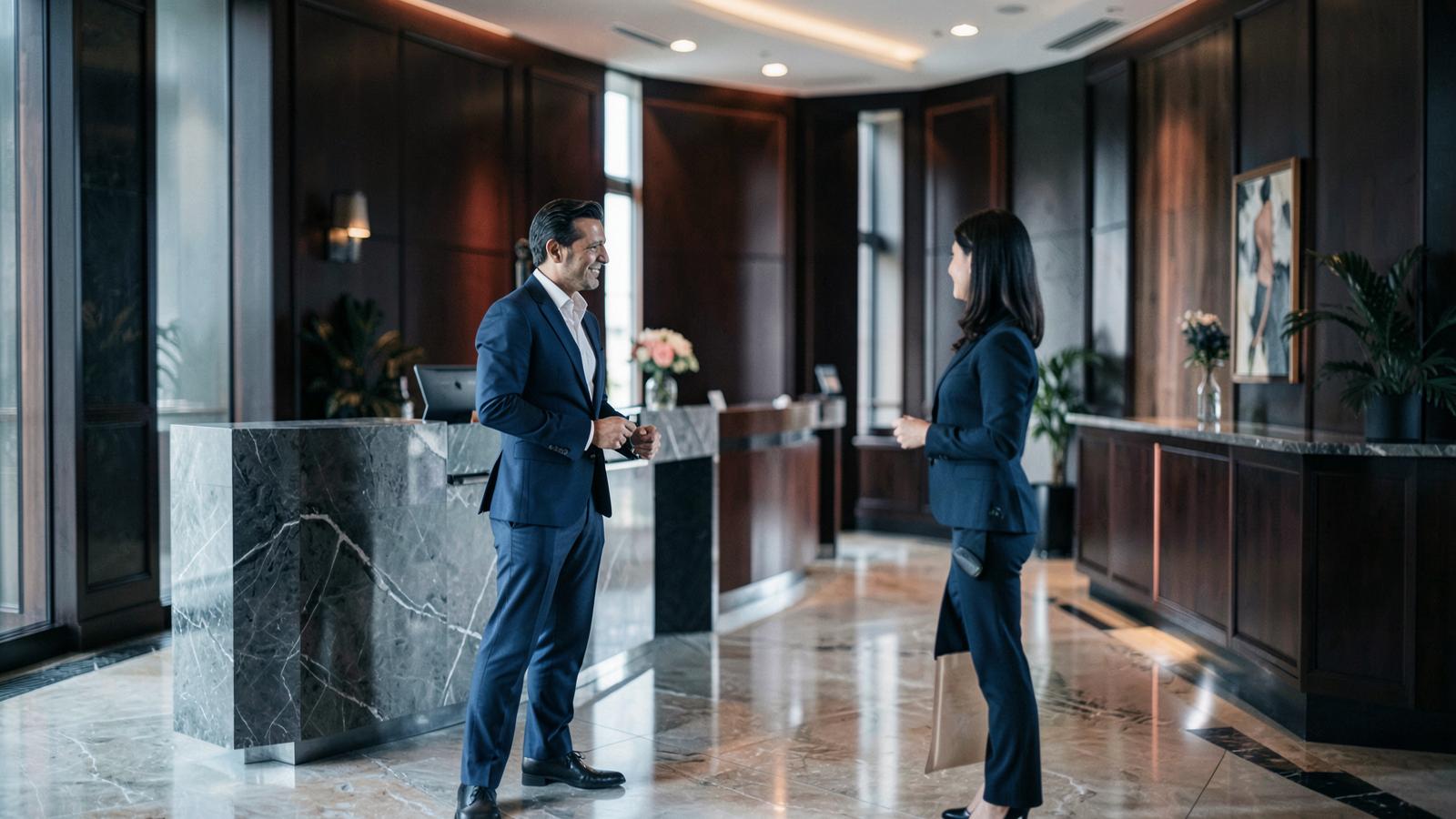
An entrance that is difficult to navigate can require visitors to find their bearings before an employee even speaks to them. The management question is specific: should staff receive more reception training, or should managers first check whether the layout makes it clear where to report?
What the literature establishes
Mary Jo Bitner (1992, Journal of Marketing) proposes a theoretical framework in which the physical service environment influences customers' and employees' responses. Ambient conditions, spatial layout and signs within the setting can contribute to approach or avoidance behaviours. This work helps frame reception as a material as well as an interpersonal experience; it is not a trial demonstrating the effectiveness of a particular layout.
Physical cues also shape expectations
Julie Baker, Ananthanarayanan Parasuraman, Dhruv Grewal and Glenn B. Voss (2002, Journal of Marketing) experimentally examine several store environment cues and their relationships with perceived value and patronage intentions. Their findings link the environment to perceptions of quality and non-monetary costs, including time and effort. The mechanism relevant to reception is inference: before experiencing the service, visitors use what they see to anticipate what it will be like.

The premature conclusion
One might conclude that a more visually polished reception necessarily produces a better experience. These studies do not justify that equivalence: an attractive appearance and effective wayfinding are not the same thing. A lobby can look professional while leaving visitors unsure which desk to approach. (our executive and employee training programmes)
What the evidence does not settle
Bitner's framework is conceptual, while the study by Baker and her colleagues concerns a retail environment: neither directly measures wayfinding errors at the entrance to an industrial or university site. Patronage intentions are not a measure of whether an actual visit is successful, either. Finally, employees familiar with the premises may consider cues obvious when a first-time visitor does not yet know how to interpret them.
A practical check in Fribourg
Within SHR's « Accueil client » programme, a practical exercise in Fribourg could examine the arrival route at an agri-food company, a bilingual industrial site or a service within the university sector. Before and after a limited change to French and German wayfinding cues, record the proportion of first-time visitors who reach the intended reception point without going to the wrong destination or receiving unsolicited staff assistance. Keeping observation periods comparable and recording visitors' preferred language and reason for visiting would help interpret the result, without treating this comparison as causal proof. This rate would provide a verifiable indicator of independent wayfinding, distinct from a general assessment of courtesy. To go further: explore the Client Reception training in Fribourg, or browse our executive and employee training programmes in Switzerland.
In pictures: Client Reception in Fribourg
- client reception
- Fribourg
- research
- training fribourg